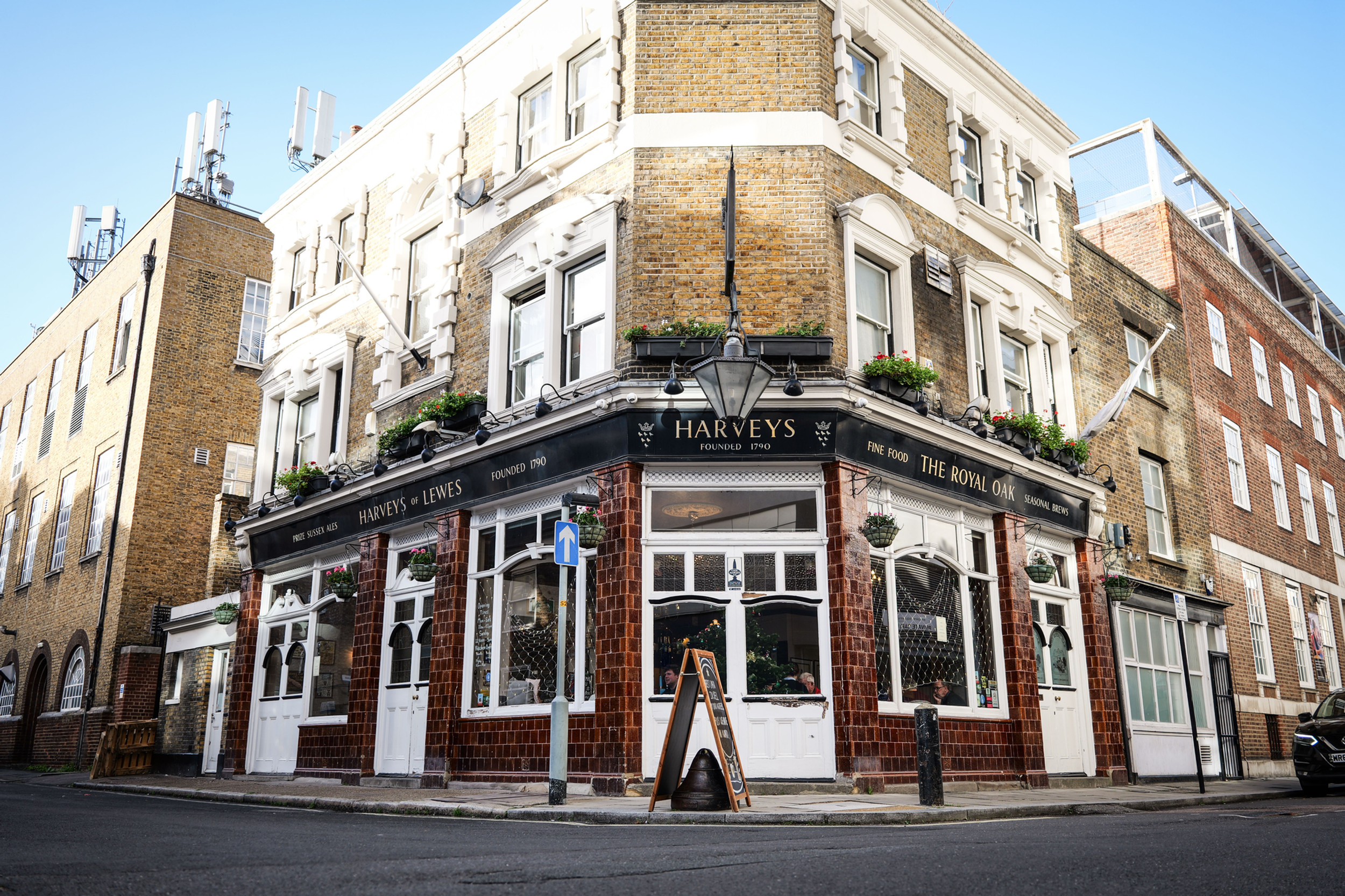
Traditional pub games are the darts, dominoes, cribbage, bar billiards and shove ha'penny that kept public bars occupied long before fruit machines and quiz apps, and almost all of them can be learned in the time it takes to drink half a pint. If you want to start tonight in London, our pick is the darts room upstairs at The Royal Oak on Tabard Street, a Victorian Harveys house with a fire in the back bar for between legs.
Why pub games come into their own when the clocks go back
The clocks went back on 25 October, and by now it is properly dark before most people have left the office. Gardens empty, conversations move inside, and an evening can drift. A game fixes that. It gives the night a shape, a reason to stay for one more, and a way of talking to strangers that needs no introduction beyond "fancy a game?" What follows covers each classic in turn: what it is, where it comes from as far as that is reliably known, how to play it, and the mistakes beginners tend to make.
Darts: the board, the history and how to play 501
Darts grew out of the throwing games played in English taverns and became a fixture of the public bar in the late Victorian and Edwardian years. Plenty of colourful origin stories circulate, including tales of archers throwing cut-down arrows at barrel ends, but treat them as pub lore rather than history. What is certain is the clever design of the modern board. Its twenty numbered segments are arranged so that high numbers sit beside low ones, with 20 at the top flanked by 1 and 5, which means a wayward throw is punished rather than rewarded. The thin outer ring scores double the segment, the thin inner ring scores treble, the outer bull is worth 25 and the bullseye 50. In standard play the throwing line, or oche, is 7ft 9¼in from the face of the board.
The game almost everyone plays is 501. Here is all you need:
- Each player or team starts on 501.
- Take turns throwing three darts, subtracting your total from your score.
- You must finish exactly on zero, and your final dart must land in a double (the bullseye counts as double 25).
- If you go below zero, land on exactly 1, or reach zero without a double, you have bust: your score returns to what it was at the start of that turn.
- The first to check out wins the leg; play best of three or five legs.
The commonest beginner's error is aiming at the bull because it looks like the target. The money is in treble 20; even a miss usually lands in a 20 or a decent neighbour. The second is forgetting to plan the finish, so leave yourself an even number you can halve into a double, ideally 32 (double 16), which gives you several chances if you clip the wrong side of the wire.
How to play bar billiards
Bar billiards came to England from the Continent in the 1930s, adapted from a billiards variant played across the Channel, and it took hold in pubs because it fitted a small room and paid for itself. The table has no pockets around the edge. Instead there are holes in the playing surface itself, each with a scoring value, the higher numbers sitting towards the far end. Small wooden pins, shaped like mushrooms, stand guard beside some of the holes.
- The timer: a coin releases the balls and starts the clock. When time runs out, a bar drops inside the table and potted balls stop coming back. You keep playing until the last ball is gone.
- The shot: every shot is played from the baulk end at the near side of the table, and you must hit another ball with the cue ball.
- Scoring: pot a ball into a hole and you score its value; the red ball usually scores double. Your turn continues as long as you keep scoring.
- The pins: knock over a white pin and you lose the points from that break. Knock over the black pin and, under the usual rules, you lose your entire score.
- Winning: whoever has the highest total when the balls run out wins.
The reason it is rare now is simple economics: the tables take up floor space a pub can fill with seats, and few are still made. Leagues survive in parts of southern England, but in London a working table is a genuine find. What people get wrong is pace. The clock tempts you to rush, but careful, low-risk shots that avoid the black pin win more games than heroics.
Dominoes and cribbage: the quiet games of the public bar
Dominoes
A standard double-six set has 28 tiles. In block dominoes, each player draws a hand, the highest double usually leads, and you take turns matching a tile to either open end of the line. If you cannot play, you knock on the table and pass; first to empty their hand wins. Fives and threes is the pub favourite: after each play, add up the spots on the two open ends, and if the total divides by five or three you score one point for each five or three it contains. A total of 15 is the jackpot, scoring eight (five threes plus three fives). Beginners tend to play their heavy tiles too late and get caught holding them.
Cribbage
Cribbage is traditionally credited to the seventeenth-century poet Sir John Suckling, and its wooden pegboard is still a familiar sight in old public bars. Each player discards two cards to the dealer's "crib", then the pegging begins: players lay cards in turn, calling the running total, scoring two for making exactly 15 or 31, plus points for pairs and runs. If you cannot play without passing 31, you say "go" and your opponent pegs one. Then hands are counted for fifteens, pairs, runs, flushes and "his nobs" (the jack matching the suit of the turned-up card). First round the board, usually to 121, wins. It sounds fiddly; after three hands it becomes second nature.
An old English pub games list: the rarer survivors
- Shove ha'penny: polished coins or discs are struck with the heel of the hand up a smooth board marked with horizontal beds; the aim is to land three in each bed.
- Table skittles: also called devil among the tailors, it involves a ball on a chain swung around a post to topple nine small pins on a tabletop.
- Aunt Sally: an Oxfordshire speciality, usually played outdoors, where players throw sticks to knock a wooden "doll" off its spindle.
- Shut the box: roll two dice and flip down numbered tiles that add up to your throw; the lowest total left standing wins.
- Nine men's morris: a strategy game for two, old enough that its boards have been found scratched into medieval stonework; form a line of three to remove an opponent's piece.
Be realistic: in London, most of these are now very hard to find. Your best chance is simply asking at the bar, because a surprising number of pubs keep a box of dominoes, a deck of cards or a cribbage board out of sight.
Where to play darts in London this winter
The Royal Oak
Borough, Southwark
Behind a tiled Victorian frontage on a Southwark corner, two rooms share one ornate central servery, dressed with etched mirrors, brass chandeliers and black-and-white prints, and there is a fireplace in the back bar for cold nights. This is a Harveys pub through and through; in the early 2000s it was reported to be the Lewes brewery's only London house, and the four cask ales on the bar run to dark mild, old ale and Armada Ale, which is exactly the kind of drinking a long game of 501 deserves. Southwark's old Court Leet once sent its official Ale Connor here to taste and approve the beer. Darts lives upstairs, away from the main bar, with a pub quiz and live music on the calendar too, so a board-and-pint evening can easily roll into something livelier. Pie, steak and Thai dishes cover supper between legs.
Board availability changes with quiz nights and events, so look at the Royal Oak's listing for opening times and ask the bar whether the board is free to use before you plan a whole evening around it.
Pub games etiquette
- Claim the next game properly: put your coin on the edge of the table or chalk your name on the board, and wait your turn.
- Winner stays on, within reason: if people are waiting, offer the board up after a few games rather than playing all night.
- Mind the oche: never walk between a thrower and the board, and keep drinks well away from a bar billiards bed.
- Ask before bringing your own set: a pub's games are part of its trade, so check with the staff before unpacking a travelling board.
- Be a good loser and a better winner: shake hands, and the winner buys the next round.
If your competitive streak runs more to general knowledge than to treble 20, our tips for winning a pub quiz cover team tactics and quizmaster manners. And if you are organising a festive night out, a darts room makes a fine centrepiece; read how to book a pub for your work Christmas party while the good dates are still available.


