
You'll often hear that the Red Lion is everywhere because James I ordered every tavern to hang his lion. That's a tradition, not a proven fact. The truer answer is that a red lion was a heraldic badge with several powerful owners, it was simple to paint and impossible to mistake, and once it hung over half the alehouses in the land, choosing it again was the safe bet.
The same logic of loyalty, legibility and imitation explains the Crown, the King's Head and the Royal Oak. Below, the stories behind each, why pubs needed pictures in the first place, and four London pubs where the old names still hang.
Why are pubs called the Red Lion?
Two heraldic explanations get cited most. The first points to 1603, when James VI of Scotland became James I of England and brought the rampant red lion of Scotland south with him; the story goes that he wanted it displayed on important buildings, inns included. The second is older: John of Gaunt, Duke of Lancaster and one of the most powerful men of the fourteenth century, used a red lion as his badge, and houses connected to his estates or sympathetic to his cause may have flown it.
Neither theory needs to be the whole truth. Lions were among the commonest beasts in heraldry, red was a cheap and striking pigment, and a landlord in a hurry could hardly pick a less controversial sign. Popularity fed on itself, which is why the name now outnumbers every rival.

The Red Lion, Mayfair
Soho, Westminster
Glass does the talking at 2 Duke of York Street. There has been a pub on this St James's corner since 1788 (it trades as Mayfair, though it sits firmly in St James's); the present building went up in 1821, and the showy ground-floor frontage was added in 1871 by the architect W.H. Rawlings. It is one of London's smallest pubs, yet the etched and cut mirrors lining the walls, the ornamental ceilings and the mahogany panelling throw reflections around until the street outside feels a long way off. CAMRA ranks the interior among the most important in the country. Study the door glass and you can read the old floor plan: four separate rooms once squeezed into this footprint. Owned by the Crown Estate and leased to Fuller's, it is the grandest proof that a common name can hang over an uncommon room. Our listing currently shows daytime-only hours, so treat it as a lunchtime pint.
The Red Lion
St James's, Westminster
Gas lamps still light Crown Passage, an alley thought to predate 1673, and partway along stands a black timber-fronted pub that a sign once billed as London's last village pub. CAMRA reckons the building is early or mid-Victorian, with an interior that looks largely 1930s: leaded casement windows with tulip-patterned roundels, wood panelling, leather pews and a stained-glass gantry over a small L-shaped bar. Royal legend clings to the place. Supposedly a tunnel ran from the cellar to St James's Palace so Nell Gwynne could slip in to see Charles II, though nothing supports it, and the tales of Henry VIII and the Duke of Windsor drinking here are just as unproven. It fills fast after work; the upstairs lounge is calmer. On a dark November evening, with the passage glowing, it's a pleasing quirk that a Red Lion should keep its address on a lane named for the Crown.
Why pubs hung picture signs at all
For most of the Middle Ages, most drinkers could not read. A word over the door was useless; a picture worked for everyone. Before painted boards, alehouses commonly advertised fresh brew with an ale-stake, a pole with a bush or bundle of greenery tied to the end.
Then the law stepped in. In 1393 Richard II is generally credited with requiring brewers and innkeepers to display a sign, so that the official ale taster, the ale conner, could find them and check the quality of what was being sold. Once every house needed an image, owners reached for symbols the public already knew: royal badges, saints, trades and coats of arms. By the eighteenth century London's hanging signs had grown so large that they became a hazard, and in the 1760s the authorities ordered projecting signs to be taken down or fixed flat to the wall.
The Royal Oak: a king, a tree and a lasting thank-you
In September 1651, after defeat at the Battle of Worcester, the young Charles II fled the Parliamentarian army and hid in an oak tree in the grounds of Boscobel House in Shropshire while soldiers searched below. When the monarchy was restored in 1660, the tree became a symbol of survival and loyalty. Charles's birthday, 29 May, was celebrated as Oak Apple Day, with people wearing sprigs of oak, and landlords took up the name in droves. It flattered the king, told a good story, and could be painted in a dozen ways.
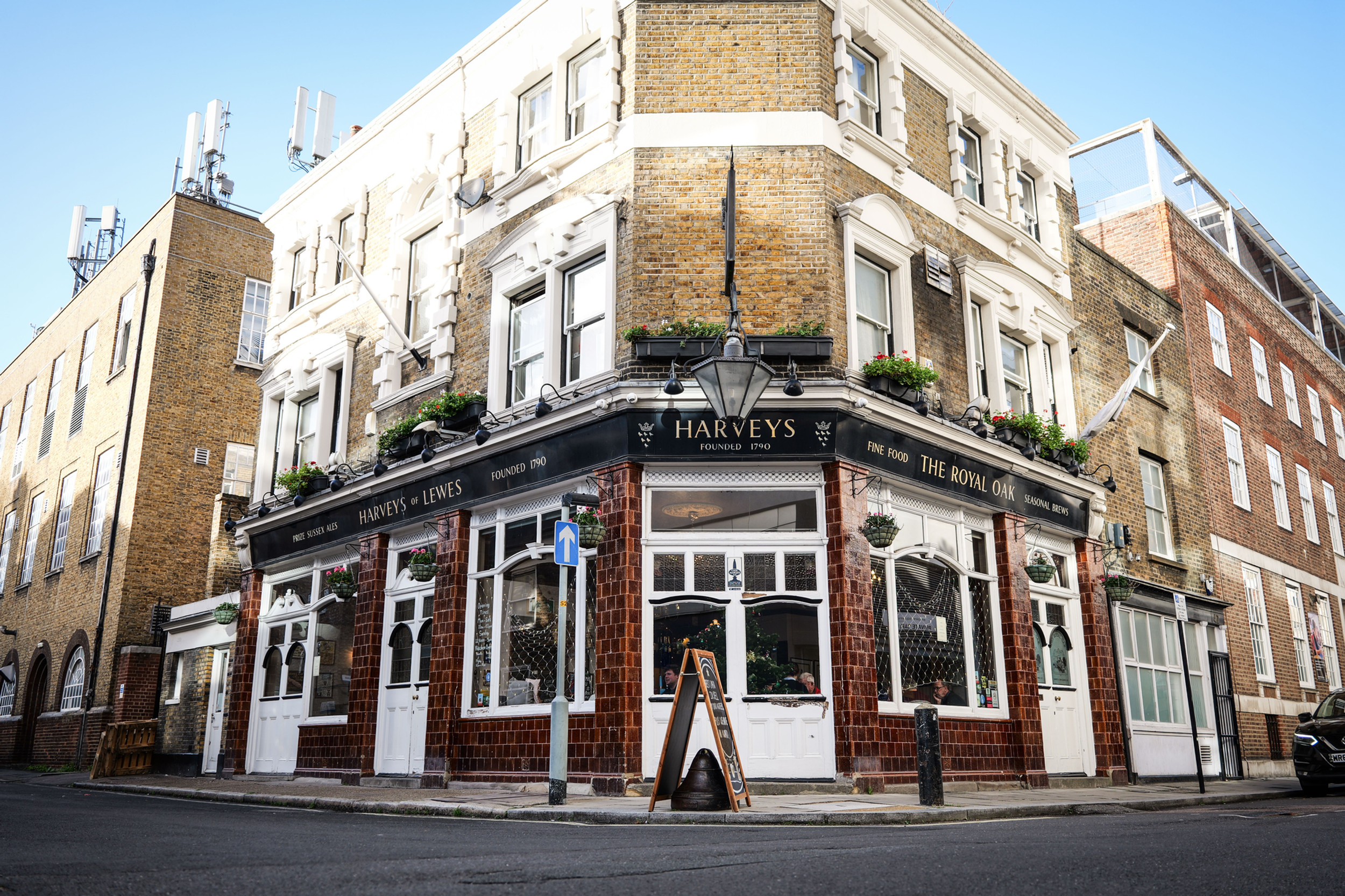
The Royal Oak
Borough, Southwark
Southwark's take on the name is a tiled Victorian corner house on Tabard Street, two rooms sharing one ornate central bar, with etched mirrors, brass chandeliers and a fireplace in the back bar that earns its keep in November. The beer comes from Harveys of Lewes, and there's a tidy local thread in that: Miles Jenner, the brewery's head brewer in the early 2000s, descends from the Jenner family of nearby Crosby Row, whose London Stout was once drunk in the capital's theatres and music halls. Better still for this story, in 2003 the Southwark Court Leet met here and its Ale Conner tasted the cask ales before formally approving them. That's the very official those medieval sign laws were written to help. A dark mild by the fire, under a name that thanks a king for hiding in a tree, makes for a properly historical evening.
The Crown and the King's Head: loyalty on a signboard
A crown was the simplest declaration a landlord could make: this house is loyal. It needed no particular monarch, so it never went out of date, which helps explain its staying power. The King's Head was more personal. Signs showed the reigning monarch, and when the throne changed hands the face could be repainted. Henry VIII remains the most familiar portrait, and a popular tale holds that after his break with Rome some Pope's Head signs were quietly turned into King's Heads. Treat that one as lore, but it captures the instinct well: when politics shifted, the sign shifted with it. The Queen's Head followed the same rules.
The King's Head
Enfield
Facing the village green at Winchmore Hill, this King's Head shows the royal name in its most classic setting. Its age depends on whom you ask. One local account dates it to the 1460s and says it was rebuilt in 1898; the records only confirm it was trading by 1826, at one stage as the Railway Hotel King's Head. That gap is a useful reminder that a royal name proves nothing about age. Today it is a Young's pub with a polished, food-led feel: stained glass, comfy sofas, eclectic decor and a library snug, with occasional live jazz. On a dark Sunday in late autumn the draw is the roast, piled high with Yorkshire puddings and homemade gravy, eaten while the green fades outside. The decked garden can wait for spring.
Other common pub names and their meanings
- Rose & Crown: the Tudor rose, merging the red rose of Lancaster and the white of York after the Wars of the Roses, set beneath a crown. Loyalty to the new dynasty in one image.
- Lamb & Flag: the Agnus Dei, the Lamb of God carrying a banner, a long-standing Christian emblem often linked by tradition to the Knights Templar.
- The George: usually St George, England's patron saint, though some later signs nod to the Georgian kings.
- White Hart: the personal badge of Richard II, the same king credited with making signs compulsory.
- The Bell, the Plough, the Wheatsheaf: trades, churches and harvests, easily painted and instantly understood.
Myths about pub names worth dropping
First, the idea that any famous name has a single, settled origin. The Red Lion has at least two plausible heraldic sources, and the James I order is repeated far more confidently than the evidence allows. Second, the belief that an old name means an old pub. Names were copied, swapped and revived constantly; the Winchmore Hill King's Head has a claimed medieval date that the records can't yet back up. Third, the assumption that royal legends attached to a pub are documented. The Crown Passage tunnel is a good story, nothing more.
If the history of who owned which pub interests you as much as what they called it, our explainer on free houses and tied pubs picks up where brewery names like Fuller's, Harveys and Young's leave off, and London's literary pubs offers another route through the city's drinking past. Hours at all four pubs above vary by day, so confirm on each listing first, especially before a winter Sunday trip.


