
London's literary pubs, in short
You have just walked out of a talk on the South Bank. It is dark before six, the river looks like ink, and the argument about the book has barely started. You need a room where the writers you have been hearing about once drank, and you want the story to be true. These four do the job: the Fitzroy Tavern in Fitzrovia, the French House in Soho, Ye Olde Cheshire Cheese off Fleet Street and the George in Southwark.
What links them is a documented literary or artistic past, not a vague claim on a chalkboard. Where the record runs thin, or a famous name rests on tradition alone, we say so. Taken in this order they make a rough west-to-east route, ending south of the river.
- Fitzroy Tavern: the pub that gave Fitzrovia its name, tied to Orwell, Dylan Thomas, Augustus John and Nina Hamnett
- The French House: a photo-lined Soho bar where phones, music and television are banned in favour of talk
- Ye Olde Cheshire Cheese: Fleet Street's warren, with a Dickens plaque and Yeats's Rhymers' Club in its past
- The George: London's last galleried coaching inn, named by Dickens in Little Dorrit
Famous writers' pubs in London, from Fitzrovia to Southwark
Fitzrovia: the pub that named a district

Fitzroy Tavern
Soho, Camden
Few pubs can claim to have christened a neighbourhood, yet this Charlotte Street corner did exactly that. It began as a coffee house, was a pub by the mid-19th century, and in time lent its name to Fitzrovia itself. Its reputation rests on the writers and artists who gathered here: George Orwell, Dylan Thomas, the painter Augustus John and Nina Hamnett, the artist sometimes remembered as the queen of bohemia, are all woven into its story. The ground floor keeps its traditional furnishings and restored interiors, and every beer comes from Samuel Smith's in Tadcaster, with Old Brewery Bitter drawn from oak casks in the cellar. These days the room fills with students, media people, locals and visitors rather than poets on their uppers. Make it your first stop, early in the evening, when there is space to sit with a pint and picture the district that grew up around its name.
Soho: a room kept for conversation
The French House
Soho, Westminster
Phones stay in pockets on Dean Street. The compact bar is hung with photographs, and there is no music, no television and no machines to compete with the talk, which is precisely the point. Its long-standing crowd runs to writers, artists, actors and film people, plus a scattering of bohemians and wide-eyed first-timers, and wine comes before beer here, with thirty champagnes and wines by the glass. Upstairs, a small dining room cooks a menu that changes with the day; warm madeleines with lemon curd are the noted finish. Stop for one glass and a proper conversation. Of all four, this is the room that most feels like the literary pub of legend, mainly because it refuses everything that would get in the way of one.
Fleet Street: a warren of rooms and poets
Ye Olde Cheshire Cheese
City of London
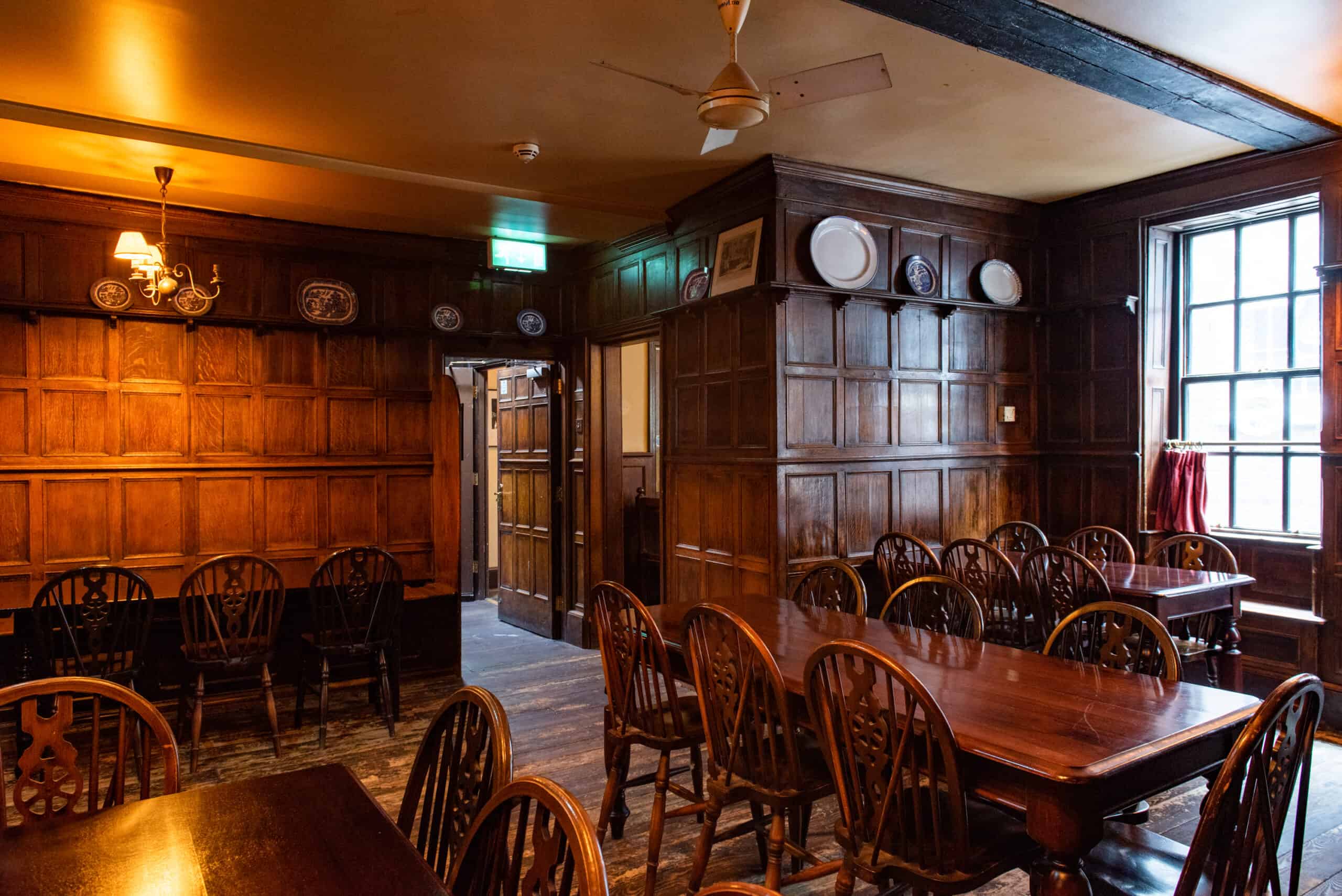
Down Wine Office Court, a slit of an alley off Fleet Street, a sign records that the building was rebuilt in 1667 after the Great Fire, on a site that had held a pub since 1538. Inside it is dim, low and gloriously confusing: old panelled rooms either side of the entrance with fixed benches and big fireplaces, lit in winter, then stairs down to vaulted cellars and up to further bars. The literary record is unusually thick. A plaque in the court says Dickens worked from the pub while producing All the Year Round, and the Cheese is alluded to in A Tale of Two Cities. From 1890 the Rhymers' Club, the poets' circle founded by W.B. Yeats and Ernest Rhys, met here; Yeats later called them "Companions of the Cheshire Cheese". Agatha Christie even sent Poirot to dine. Aim for mid-afternoon or a dark November evening, take a bench by the fire, and look out for Polly, the notoriously foul-mouthed parrot whose stuffed body is still on show.
Southwark: the galleried inn
George
Borough, Southwark
Step off Borough High Street into the cobbled yard and the reason to come is right above you: two tiers of timber galleries, the lower on cantilevered beams, the upper on wooden Doric columns, the woodwork visibly warped with age. Rebuilt in 1676–77 after fire swept Southwark, this is London's last galleried coaching inn, and only its south wing survives, after railway companies pulled down the rest in the 1870s and 1880s. The National Trust has owned it since 1937. Dickens names the George in Little Dorrit, and a plaque at the High Street entrance says as much. Inn yards like this served as theatres before playhouses existed, and Elizabethan plays are still staged here each year, mostly by amateur companies. On big match days the courtyard leans towards football, so head inside, into the maze of small rooms and creaking stairs, or upstairs to the panelled rooms if they are open, and finish the night where London's stories were once performed.
What about the famous Dickens pubs?
Dickens walked London obsessively and wrote it into almost everything, so a great many pubs claim him. Plenty of those claims amount to little more than "he might have passed". We have only repeated links with something solid behind them: the plaque in Wine Office Court and the nod in A Tale of Two Cities at the Cheshire Cheese, and the mention in Little Dorrit at the George.
Even good pubs mix fact with folklore. The Cheese displays Dr Johnson's chair and portrait, though several sources say there is no evidence he ever drank there. At the George, a plaque says both Shakespeare and Dickens "knew the hospitality" of the inn; the Shakespeare half is tradition, not record, and the idea that Dickens visited when it was a coffee house is likewise only said to be so. Enjoy these tales as part of the furniture, but treat any pub sign reading "Dickens drank here" with healthy scepticism.
Making a night of it around the London Literature Festival
The Southbank Centre's London Literature Festival usually opens in late October, and the dates shift from year to year, so check the Southbank Centre's own listings rather than any date you see quoted elsewhere. If this year's run has already closed, the plan still works for any author talk on its winter calendar, and the next festival is worth putting in the diary.
The simplest pairing keeps you south of the river: follow the Thames east to the George and argue about what you have just heard under those galleries. If the talk touched on Victorian London or the 1890s poets, cross the water instead and lose yourself in the Cheshire Cheese, where a lit fire on a cold November night is the whole argument for going. Save Fitzrovia and Soho for a longer evening, starting early on Charlotte Street and drifting down to Dean Street.
Before you go
Opening hours vary through the week, and some of these rooms are small: the French House's upstairs dining room takes groups of up to six, and the Cheese's oldest rooms fill quickly at peak times. Look up the latest hours and booking details on each pub's profile or its own website. If one of them has caught your eye for the office do, our piece on booking a pub for a work Christmas party explains why November is the moment to move.


